

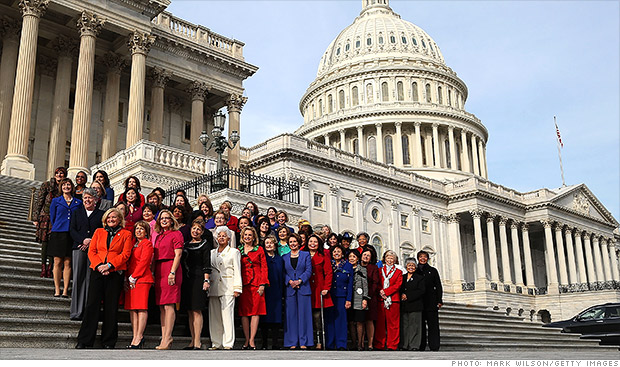
Women House Members in 2013. Photo by Getty Images.
When the new Congress takes office in early January 2015 it will include a record number of women lawmakers. More than 100 female members out of 535 will serve — the precise number is unclear, since a few House races are still too close to call, and Sen. Mary Landrieu (D-La.) faces a December runoff to hold her seat.
While there’s still a long way to go toward equal representation, this is progress. Especially considering not that long ago Capitol Hill was a clubby, male-dominated environment.
This slow-but-steady shift toward egalitarianism may have other benefits beyond increasing diversity. It’s possible that the increased ranks of female lawmakers will diminish the political jargon, pabulum and empty stock phrases so often bandied about in Washington. There may be more focus on accomplishing something, rather than rank political gamesmanship. “We’re good problem-solvers. When you look at what happened here with the shutdown, and who ultimately came to the table to resolve that: women on both sides of the aisle,” Rep. Alma Adams (D-N.C.) told The Hill shortly after taking office in early November.
Here are some commonplace-for-politics phrases most likely to affect the growing ranks of women in high office — for better or worse. These are adapted from the new book political journalist Chuck McCutcheon and I wrote, Dog Whistles, Walk-Backs, and Washington Handshakes: Decoding the Jargon, Slang and Bluster of American Political Speech
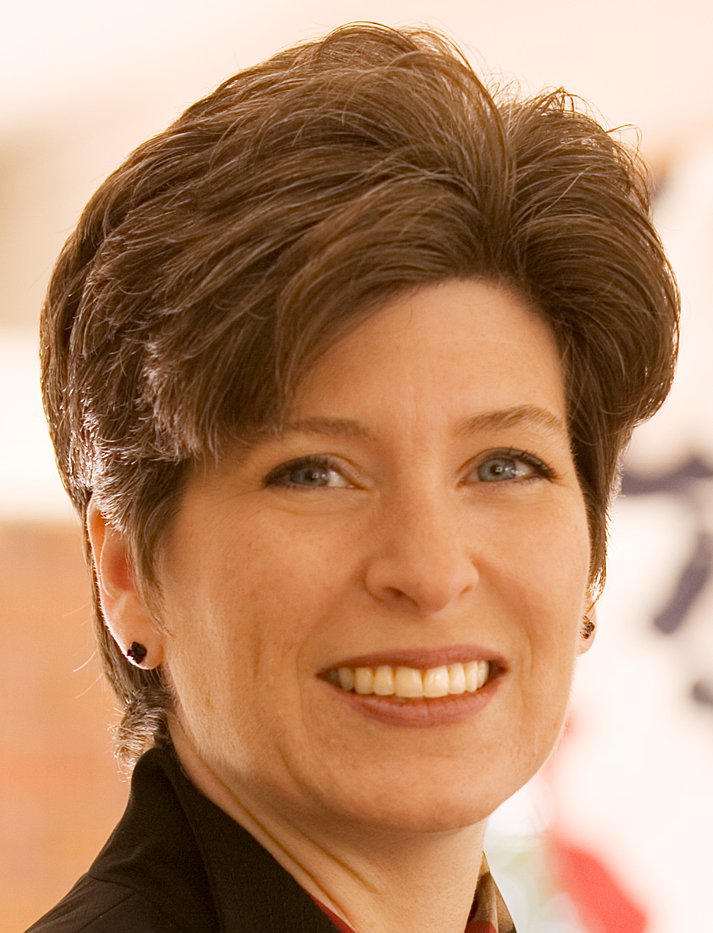
Senator-Elect Joni Ernst. Isn’t she attractive? Photo by IowaPolitics.com
“Attractive”
Saying a woman is attractive is usually a compliment. Not so much in politics, where any reference by a male officeholder to a female’s physical appearance can be poisonous.
Democratic Sen. Tom Harkin found that out in the closing hours of the 2014 election cycle. The four-decade Iowa member of Congress, retiring after the end of the year, was trying to boost the chances of the Democratic nominee to succeed him, Rep. Bruce Braley. Harkin took what was clearly intended as a backhanded compliment — at best — of the Republican candidate, state Sen. Joni Ernst.
Harkin said that Iowa voters shouldn’t be fooled because Joni Ernst is “really attractive” and “sounds nice.”
“In this Senate race, I’ve been watching some of these ads,” Harkin told a Democratic gathering. “And there’s sort of this sense that, ‘Well, I hear so much about Joni Ernst. She is really attractive, and she sounds nice.’”
“Well, I got to thinking about that. I don’t care if she’s as good looking as Taylor Swift or as nice as Mr. Rogers, but if she votes like Michele Bachmann, she’s wrong for the state of Iowa.”
Not surprisingly, Republicans pounced on what they called Harkin’s sexist remarks. “Fossilized Democrat Tom Harkin patronizes Joni Ernst,” went a headline on the conservative site Breitbart.com.
Harkin’s comments clearly didn’t help the cause of the candidate he was trying to promote. Democratic nominee Braley lost the Senate race to Ernst in one of the Republicans’ biggest pickups of 2014.
Harkin isn’t the first politician to face heat for praising a female colleague’s appearance. Even if they really mean it as a compliment, as President Barack Obama did in talking up California Attorney General Kamala Harris at an April 2013 fundraiser in Northern California. Harris, the president said, is “by far, the best looking attorney general,” after praising the quality of her work.
This time criticism came from Obama’s own ideological side. “It’s a shame to see him undermine his enlightened policies with comments that highlight women’s ever-present decorative duties,” feminist writer Amanda Marcotte intoned. “Especially when we know for a fact that such remarks erode women’s opportunities and even their own sense of deserving equality.”
“I Want To Spend More Time with My Family”
One of the most pervasive euphemisms in the government and business worlds, it’s the lame excuse when somebody doesn’t want to provide the real reason for departing a job.
The expression has become a cliché, and as such, an object of regular ridicule. During a rough political patch for President Obama in May 2013, Dana Perino — President George W. Bush’s former spokeswoman — tweeted: “I predict that someone soon in the [White House] will be deciding to spend more time with his or her family.”
Laura Vanderkam, author of two books on balancing work and family life, dislikes the expression for several reasons. “The people who use this phrase tend to be near the top of organizations, which grants them reasonable control of their time,” she wrote in a 2013 column. “If you want to come in late because you’re bringing your kid to school once or twice a week, you’re probably not going to get fired. If you can schedule lunches with donors, you can schedule lunch with your spouse.”
“Presenting ‘demanding job’ and ‘time with family’ as opposing forces contributes to the false choice duality so prevalent in the popular narrative.”
“Mr./Madame Chairwoman”
In the high school-like atmosphere that prevails in Congress, only a small group of lawmakers have significant power. Along with the elected leadership in the House and Senate, committee chairmen and chairwomen can wield real clout.
It’s customary to give these powerful barons due deference. Colleagues refer to committee heads as “Mr. Chairman” or, more commonly these days, “Madame Chairwoman.”
“San Francisco Values”

Photo by Bill Badzo.
Conservative nomenclature for someone who’s even further left and more radical than a standard liberal — a pot-smoking, gay/bisexual, hedonistic, Grateful Dead-loving, vegetarian socialist. “San Francisco values” took on new life when the city’s congresswoman, Nancy Pelosi, ascended to speaker of the House after the Democrats’ 2006 midterm election romp.
But the reality is that San Francisco is in many ways the opposite of a welfare state. It has long been home to a thriving technology startup culture. Even those cited as symbolizing its permissiveness, like Pelosi, are in many was upholders of traditional values. She’s an Italian Catholic grandmother who’s been married to the same man for more than 50 years.
David Mark (@DavdiMarkDC) is a former Politico senior editor and co-author of the new book Dog Whistles, Walk-Backs, and Washington Handshakes: Decoding the Jargon, Slang, and Bluster of American Political Speech. Learn more at the book’s website.